
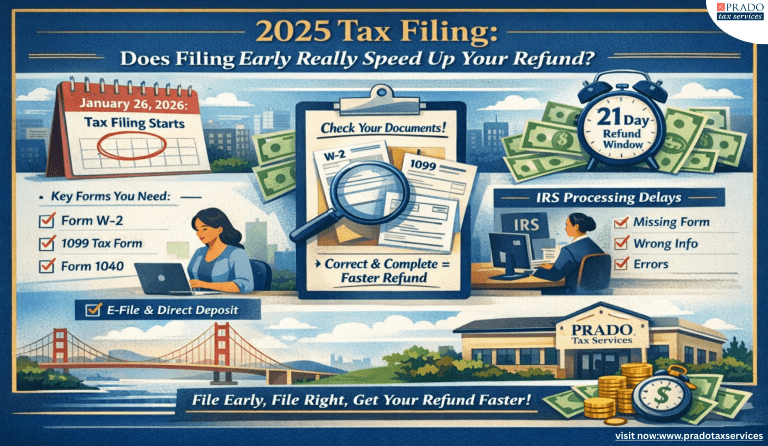
Tax season is here, and for most people, the first thing on their mind is a refund. The goal is to receive it quickly, ensure accuracy, and avoid any unexpected issues. The question many taxpayers ask every year is simple. If you file your taxes early, do you really get your money back faster?
The answer is yes, but only when tax filing is done correctly. Filing early helps your income tax return reach the IRS before peak season, but timing alone is not enough. The way the IRS processes returns, the documents you include, and how you file all affect how quickly your refund arrives.
This article explains the 2025 tax filing start date, how IRS tax filing works, and what actually helps speed up your refund. Everything is explained clearly, so you can file with confidence this tax season.
2025 tax filing start date
The 2025 tax filing start date refers to when the IRS officially began accepting tax returns for income earned during 2025. The IRS opened the 2026 filing season on January 26, 2026. Before this date, IRS systems were not open to receive or process any income tax returns.
Each year, the IRS sets a start date to update its systems, release updated tax forms, and prepare for millions of filings. For the 2026 filing season, January 26 marked the official opening day. The IRS also introduced new tools, resources, and tax law updates that may affect credits and deductions for some taxpayers. The IRS announced key details about the 2026 filing season, including preparation guidance for taxpayers.
Understanding the start date is an important part of tax filing, but staying aware of other deadlines throughout the season is just as important for avoiding delays.
| Date | What It Means |
| January 9, 2026 | The IRS Free File program opened early for people earning $84,000 or less. If you qualify, this is a free way to file. |
| January 26, 2026 | The official start of the 2026 tax filing season. This is when the IRS started accepting 2025 tax returns from everyone. |
| January 31, 2026 | The deadline for your employer to mail or send you your Form W-2. If you still haven’t received it, you should contact your employer. |
| April 15, 2026 | The main tax filing deadline. Your income tax return must be filed by this date to avoid late fees or penalties. |
| October 15, 2026 | If you requested an extension, this is the final deadline to file your income tax return without penalties. |
Staying aware of these dates helps ensure your tax filing stays smooth and avoids penalties or refund delays.
Does filing early really give you a faster refund
In most cases, yes. Filing early often results in a faster refund, especially when combined with electronic filing and direct deposit. However, early filing only works when your income tax return is accurate and complete.
The role of e-filing
Electronic filing sends your tax return directly to the IRS system. There is no waiting for mail delivery and no manual processing delays. Returns submitted electronically begin processing almost immediately. Paper returns take much longer to enter the system, which often delays refunds.
Choosing direct deposit
Direct deposit is the fastest way to receive your refund. When selected during IRS tax filing, the IRS sends your refund straight to your bank account. This avoids delays caused by printing and mailing checks and often significantly shortens wait times.
The 21-day window
The IRS states that most refunds are issued within 21 days when you file and choose direct deposit. While this is not guaranteed for every taxpayer, it applies to the majority of correctly filed returns.
So what does filing early actually do?
Filing early does not change how long the IRS takes to process a return. What it does is place your income tax return into the system before the busiest part of the season. As the April deadline approaches, millions of taxpayers file at the same time, which can slow processing.
Filing early only helps if your return is ready. Submitting your return without all the required documents, such as a missing form W-2 or 1099 tax form, can cause delays and reviews. Early and accurate tax filing is what truly helps speed things up.
What forms do you actually need before you file
The main form form 1040
Form 1040 is the foundation of your income tax return. It summarizes your total income, taxes paid, deductions, credits, and refund or balance due. Nearly all taxpayers use this form.
The forms that show how you earned your money
Now, before you can fill out that 1040 tax return form, you need the forms that actually prove how much money you made during the year. These are the forms your employer or anyone who paid you sends out. Here’s a simple look at the two big ones and what they each do:
| Form | Who Sends It to You | What It Shows |
| Form W-2 | Your employer, meaning the company or organization where you work a regular job | Your total wages for the year and the amount of federal, state, and other taxes withheld from your paychecks. If you worked for more than one employer, you will receive a separate Form W-2 from each. |
| 1099 Tax Form | A person or organization that paid you outside of a regular job, such as a freelance client, financial institution, or online platform | Income earned from freelance work, interest, dividends, or other non-payroll sources. Different 1099 forms exist depending on the income type, but they all report payments made to you to the IRS. |
The IRS already receives copies of these forms. Any mismatch between what you report and what the IRS has on file can delay your refund.
Other forms you might need
Depending on your situation, a few other forms might show up. Not everyone needs all of these, but it’s good to know they exist so you’re not caught off guard.
- Form 1095-A — If you got your health insurance through a government marketplace like Healthcare.gov, you’ll get this form. It shows the details of your insurance plan and any money the government helped you pay toward it. You need this to fill in the health insurance part of your return correctly.
- Your Social Security number — This isn’t a form, but it’s just as important as any form on this list. You need your own Social Security number, and if you’re filing for a spouse or kids, you need theirs too. The IRS uses this to match your return to the right person. Without it, nothing moves forward.
- A copy of last year’s tax return — If you filed taxes last year, having that old return nearby can actually help you this year. Some online tax filing systems ask you to type in a number from your previous return just to confirm you are who you say you are. It’s a quick step, but you can’t do it if you don’t have the paper handy.
If you need to look up or download a specific form, Prado Tax has a full list of all the forms people use most often, and you can find them all in one place right here: Frequently Used Tax Forms. It’s a handy spot to bookmark, especially if you’re not sure which form you need or what a certain form number actually means.
What mistakes slow your refund down
Filing early helps, but only if your income tax return is accurate. When you submit your return, the IRS compares it with information they already have. Your employer reports your form W-2, banks report interest, and anyone who paid you reports income through a 1099 tax form. If the details on your return do not match IRS records, your refund is paused until the issue is resolved. This is a normal part of IRS tax filing, not a penalty.
The big mistakes that hold up your refund
Most refund delays come from small and avoidable errors. These mistakes usually happen when tax filing is rushed or when documents are missing. Below is a simplified table showing the most common issues and why they slow things down.
| The Mistake | Why It Slows Your Refund Down |
| Missing a Form W-2 or 1099 tax form | The IRS already has copies of these forms. If your income tax return does not include them, the numbers will not match and your return will be held. |
| Incorrect Social Security number | If the Social Security number does not match IRS records, the return is rejected and must be corrected. |
| Wrong bank account details | Incorrect routing or account numbers prevent direct deposit and can delay your refund or result in a paper check. |
| Income reported in the wrong section | Wages and freelance income are reported differently. Errors often trigger additional IRS review. |
| Missing side or gig income | Income reported by others but not included on your return creates mismatches that the IRS must investigate. |
| Unsigned return | An unsigned return is treated as not filed, whether submitted on paper or electronically. |
| Claiming credits you do not qualify for | Incorrect credits often cause the IRS to review the entire income tax return. |
| Using last year’s numbers | The IRS matches your return to current-year records, not prior-year data. |
Why even small things matter here
Even a small error can stop your refund from moving forward. The IRS system requires every number on your return to match what is already on file. If something does not line up, the entire return is paused until corrected. Reviewing your return carefully before submitting it is one of the easiest and most effective tax management steps you can take.
The good news is that these issues are easy to avoid with proper preparation. Taking a few extra minutes to review your Form W-2 and 1099 tax forms can prevent weeks of refund delays. This is especially important for California taxpayers with multiple income sources.
How does online tax filing actually work
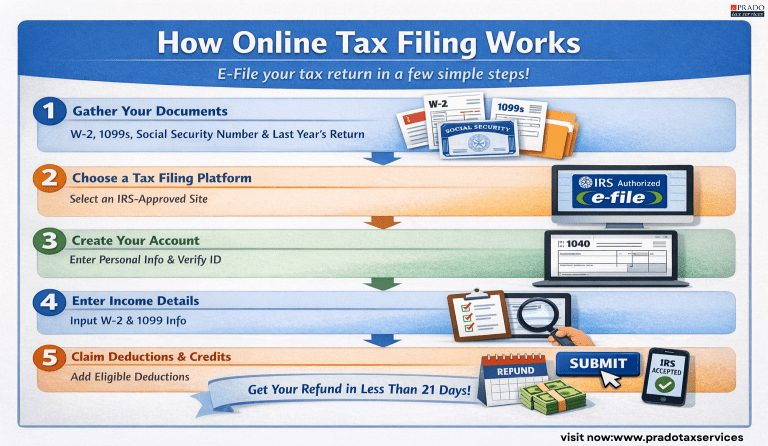
Online tax filing is one of the fastest ways to submit an income tax return. It sends your return directly to the IRS, reduces errors, and helps refunds arrive sooner when filed correctly.
Step 1: Gather all your documents first
Collect your Form W-2, any 1099 tax form, your Social Security number, and last year’s income tax return if available. Filing without all documents often causes delays.
Step 2: Pick the right online tax filing platform
Choose an IRS-authorized platform. Many taxpayers qualify for IRS Free File. Always confirm the platform is approved for IRS tax filing.
Step 3: Create an account and enter basic information
Enter your personal details and verify your identity. This step protects your tax filing and prevents fraud.
Step 4: Enter your income information
Use your Form W-2 and 1099 tax forms to enter income details. The platform completes Form 1040 automatically as part of your income tax return.
Step 5: Claim your deductions and credits
Answer simple questions to apply eligible deductions and credits that may increase your refund.
Step 6: Review everything before you submit
Check names, numbers, income totals, and bank details. Small mistakes can delay IRS tax filing refunds.
Step 7: Submit your return and save the confirmation
Submit your return and save the IRS confirmation as proof of filing.
After you submit, how long until your refund shows up
Most refunds arrive within 21 days when you file and choose direct deposit. You can track progress using the IRS refund tool.
Why tax management matters before you file
Tax management simply means getting organized before you file your income tax return. It is not about being an expert. It is about knowing what forms you need, how much income you earned, and what deductions or credits may apply.
When documents are gathered early, tax filing feels calmer and less rushed. Waiting until the last minute often leads to mistakes, missed information, and delays.
Good tax management includes tracking your income, keeping last year’s return handy, and reviewing your Form W-2 or 1099 tax form before filing. A little preparation makes tax season smoother and helps your income tax return get processed faster.
If you live in the Bay Area, California, here’s what to know
Tax filing in California can be more complex than in other states. Federal and state rules differ, and inconsistencies between returns can delay refunds.
Personal taxes in the Bay Area
Even simple returns can cause problems if California and federal filings do not align, leading to higher personal tax liability or delays. Many residents rely on Bay Area Tax Services, and experienced San Francisco tax services help keep returns accurate and compliant.
If you run a business
Business owners face additional challenges, such as sales tax reporting and business income classification. Bay Area Tax Services that specialize in business taxes help ensure compliance and accuracy while saving time.
Prado Tax Services, based in San Leandro, has supported individuals and businesses since 2007. Their hands-on approach helps ensure each income tax return is accurate before filing.
Ready to file?
So, does filing early actually speed up your IRS tax refund? The answer is yes, but only when it is done correctly. Filing early places your income tax return in the system before the busiest period, but submitting incomplete or incorrect information can cause delays instead of faster refunds.
Tax filing does not need to be stressful. Having the right documents and taking time to file accurately make the biggest difference. A correct return is always processed faster than a rushed one.
If you are in the Bay Area and want help filing with confidence, Contact Prado Tax Services Today. Based in San Leandro, for nearly 20 years, we have assisted taxpayers, and filing early and correctly helps ensure your refund is processed and delivered as quickly as possible.