
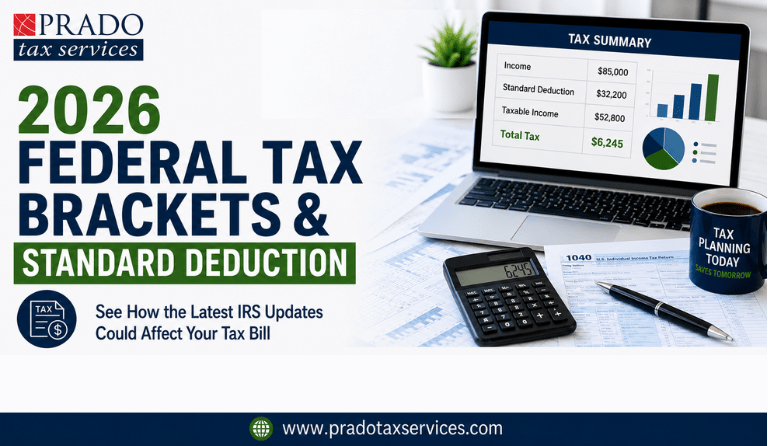
Every year, millions of taxpayers wait for the IRS to announce updated tax brackets and deduction amounts, hoping they’ll pay less in taxes. It’s an understandable reaction. When you hear about higher 2026 federal tax brackets or an increased 2026 standard deduction, it sounds like good news for your wallet. But the reality isn’t quite that simple.
Whether the 2026 federal tax brackets and standard deduction lower your tax bill depends on your specific tax situation. Your filing status, taxable income, available deductions, tax credits, and changes in your earnings can all affect how much federal income tax you ultimately owe. If you’re unsure how these 2026 tax changes could affect your return, professional Tax Preparation Services can help you review your tax situation and understand their potential impact. While the updated brackets and standard deduction may lead to tax savings for many taxpayers, the results won’t be the same for everyone.
That’s why it’s worth looking beyond the headlines. This guide explains how the 2026 federal tax brackets and 2026 standard deduction work together, who is most likely to benefit from the new thresholds, who may see little change, and how you can estimate your own tax bill before filing your tax return in 2026.
Why Everyone Is Talking About the 2026 Federal Tax Brackets
The 2026 federal tax brackets are getting plenty of attention because they play a direct role in how much federal income tax you may owe. Every year, the IRS reviews inflation and adjusts income thresholds to reflect changes in the economy. The official IRS tax inflation adjustments for 2026 explain how these annual updates affect tax brackets and the standard deduction. These annual updates are designed to help taxpayers keep pace with rising costs and reduce the impact of inflation on their tax burden.
Federal tax brackets work on a progressive tax system, which means your income isn’t taxed at one flat rate. Instead, different portions of your taxable income are taxed at different rates. As your income increases, only the income that falls within the next bracket is taxed at the higher marginal tax rate. The rest continues to be taxed at the lower rates that apply to those income ranges.
The IRS updates these brackets each year because wages often rise alongside inflation. Without these adjustments, taxpayers could end up paying more tax even if their purchasing power hasn’t really changed. These annual threshold changes, along with other updated tax rules for 2025–2026, can affect how much income falls within each tax bracket. By increasing the income thresholds, the IRS tax brackets help reduce what’s commonly known as “bracket creep,” allowing many taxpayers to keep more of their earnings.
Understanding how the 2026 tax brackets work is the first step toward estimating your tax bill accurately. When combined with the 2026 standard deduction, these updated thresholds determine how much of your income is actually subject to tax.
What Is the 2026 Standard Deduction?
The 2026 standard deduction is one of the easiest ways to reduce the amount of income that’s subject to tax. Instead of listing every eligible expense on your tax return, you can claim a fixed deduction set by the IRS. This amount is subtracted from your total income before your federal income tax is calculated, which helps lower your taxable income.
For most taxpayers in California, claiming the standard deduction 2026 is the simpler option. It saves time, reduces paperwork, and often provides a larger tax benefit than itemizing deductions. However, if your deductible expenses, such as mortgage interest, charitable donations, or certain medical expenses, exceed the standard deduction, itemizing may result in greater tax savings.
Understanding how the standard deduction affects your taxable income can be easier with professional guidance. If you’re looking for tax services in San Leandro, working with experienced tax professionals can help you determine whether claiming the standard deduction or itemizing deductions will provide the greatest tax savings based on your financial situation.
Like the federal tax brackets, the IRS adjusts the standard deduction each year to account for inflation. A higher standard deduction means more of your income may be protected from federal income tax, potentially lowering your overall tax bill. If you’re unsure whether claiming the standard deduction or itemizing deductions is the better option, experienced professionals offering personal tax services in San Leandro can review your financial situation and recommend the approach that provides the greatest tax benefit.
2026 Standard Deduction by Filing Status
Filing Status | 2026 Standard Deduction |
Single | $16,100 |
Married Filing Jointly | $32,200 |
Married Filing Separately | $16,100 |
Head of Household | $24,150 |
Will the 2026 Tax Changes Actually Lower Your Tax Bill?
This is the question most taxpayers want answered, and the honest answer is it depends. The 2026 federal tax brackets and 2026 standard deduction could reduce your tax bill, but the amount you save varies based on your filing status, taxable income, deductions, and any tax credits you qualify for. Some people may notice meaningful tax savings, while others may see only a small difference.
Building a proactive tax planning strategy before filing season can help reduce your taxable income and identify additional deductions. You can also find more tax-saving articles on our Tax Blog.
A higher standard deduction lowers the amount of income that’s subject to tax, and updated tax brackets can reduce the amount of income taxed at higher rates. Together, these 2026 tax changes may work in your favor, especially if your income has remained relatively stable. However, if your earnings increased significantly or your financial situation changed during the year, the impact may be different.
Let’s look at how these changes may affect different taxpayers.
If You're a Single Filer
If you file as Single, an increase in the 2026 standard deduction may reduce your taxable income before any tax rates are applied. Updated 2026 federal tax brackets may also allow more of your income to be taxed at lower rates. If your income stayed about the same compared to last year, you could see a modest reduction in your overall tax bill.
If You're Married Filing Jointly
Married couples filing jointly generally benefit from a larger standard deduction than single filers. Combined with the updated federal income tax brackets for 2026, these changes may lower the amount of income taxed at higher rates. Families with changing financial circumstances can benefit from professional guidance, and family tax services in San Leandro can help evaluate filing status, available deductions, tax credits, and long-term tax planning strategies.
If You're Head of Household
Taxpayers filing as Head of Household often receive a higher standard deduction than single filers, along with different tax bracket thresholds. If you qualify for this filing status, the 2026 tax brackets and updated deductions may reduce your taxable income and help lower your overall tax liability, especially if you’re supporting dependents.
If Your Income Increased This Year
A raise or higher earnings doesn’t automatically mean you’ll pay dramatically more in taxes. The U.S. tax system is progressive, so only the portion of your income that falls into a higher marginal tax rate is taxed at that higher percentage. Depending on how much your income increased, the larger 2026 standard deduction and updated tax brackets may help offset some of that increase. That’s why it’s important to look at your entire tax situation rather than focusing only on your income.
Understanding these factors gives you a clearer picture of how the 2026 federal tax brackets and the 2026 standard deduction work together. Next, let’s look at a few real-life examples to see how these changes may affect different taxpayers in practical situations.
Federal Tax Brackets vs. Standard Deduction: What's the Difference?
The 2026 federal tax brackets and the 2026 standard deduction are often mentioned together, but they serve two very different purposes. Understanding how they work together can make it much easier to estimate your tax bill and avoid common misconceptions.
Think of it this way: the standard deduction reduces the amount of income you have to pay taxes on. Once that deduction is applied, the federal tax brackets determine how the remaining taxable income is taxed. In simple terms, the standard deduction lowers your taxable income first, and the tax brackets decide how much tax you owe on what’s left.
The table below highlights the key differences.
Federal Tax Brackets | Standard Deduction |
Determines how your taxable income is taxed. | Reduces your taxable income before taxes are calculated. |
Based on income ranges set by the IRS. | Based on your filing status. |
Uses a marginal tax rate, so different portions of your income are taxed at different rates. | Applies as a fixed deduction before your tax is calculated. |
Helps determine your total federal income tax liability. | Helps lower the amount of income subject to tax, potentially increasing your tax savings. |
Imagine you earn $55,000 and qualify for the 2026 standard deduction of $16,100 as a single filer. Instead of paying tax on the full $55,000, your taxable income is reduced to $38,900. The 2026 federal tax brackets are then applied only to that $38,900, not your entire salary.
Understanding this relationship is one of the easiest ways to see how the 2026 tax changes may affect your overall tax bill. Once you know how deductions and tax brackets work together, estimating your taxes becomes much less confusing.
What Won't Change Your Tax Bill in 2026
The 2026 federal tax brackets and 2026 standard deduction may change how much of your income is subject to tax, but they don’t change some of the basic rules of the U.S. tax system. Unfortunately, a few common myths continue to confuse taxpayers every year. Understanding the facts can help you estimate your tax bill more accurately and avoid unpleasant surprises when it’s time to file your tax return in 2026.
Common Misconceptions Include:
- A higher tax bracket doesn’t mean all of your income is taxed at that rate. Only the portion of your taxable income that falls within the higher bracket is taxed at that higher marginal tax rate.
- A pay raise doesn’t automatically lead to a dramatically higher tax bill. Thanks to the progressive tax system, most of your income continues to be taxed at the lower rates.
- A larger 2026 standard deduction doesn’t always mean you’ll receive a bigger tax refund. Your refund also depends on factors like tax withholding, tax credits, and other deductions claimed during the year.
- Tax credits can still have a major impact on what you owe. While the 2026 federal tax brackets determine how your income is taxed, eligible tax credits directly reduce your final federal income tax liability.
- Your filing status matters just as much as your income. Whether you file as Single, Married Filing Jointly, or Head of Household can significantly affect your standard deduction, applicable tax brackets, and overall tax bill.
The key takeaway is simple: don’t rely on headlines or common myths when evaluating the 2026 tax changes. Looking at your income, filing status, deductions, and credits together will give you a much clearer picture of what you may owe and where you might find valuable tax savings.
How to Estimate Your 2026 Tax Bill Using the New Tax Brackets
Now that you understand how the 2026 federal tax brackets and 2026 standard deduction work, you can make a rough estimate of your tax bill before filing your return. Taking time to prepare for tax filing in 2026 can also help you organize your income records, review potential deductions, and identify changes that may affect your return. While this won’t replace a professional tax calculation, San Francisco tax preparation services can provide personalized guidance based on your income, filing status, deductions, and available tax credits.
Follow these simple steps to estimate your tax return for 2026.
Step 1: Determine Your Filing Status
Start by identifying your filing status. Whether you file as Single, Married Filing Jointly, Married Filing Separately, or Head of Household affects both your 2026 standard deduction and the federal income tax brackets 2026 that apply to you.
Step 2: Estimate Your Total Taxable Income
Add together all taxable sources of income, including wages, self-employment earnings, interest, and other taxable income. This gives you an estimate of your total income before deductions.
Step 3: Subtract the 2026 Standard Deduction
Next, subtract the 2026 standard deduction that matches your filing status. This reduces the amount of income that’s subject to federal income tax.
Step 4: Apply the Appropriate 2026 Federal Tax Brackets
Use the 2026 federal tax brackets to calculate how each portion of your taxable income is taxed. Remember, the U.S. tax system is progressive, so different portions of your income are taxed at different marginal tax rates.
Step 5: Factor in Any Available Tax Credits and Deductions
If you’re eligible for tax credits or additional deductions, apply them after calculating your estimated tax. These can further reduce the amount of tax you owe and increase your potential tax savings.
If your finances are straightforward, these steps can provide a reasonable estimate of your 2026 tax bill. However, if you’re self-employed, own investments, have multiple income sources, or experienced major life changes during the year, your tax situation may be more complex. Consulting the experienced tax professionals at Prado Tax Services in San Leandro can help you understand how the 2026 tax changes apply to your finances, identify potential tax-saving opportunities, and file with confidence while avoiding costly mistakes.
When Should You Review Your 2026 Tax Situation?
The 2026 federal tax brackets and 2026 standard deduction can affect your tax bill differently depending on your financial situation. Reviewing your taxes before filing season gives you time to understand the changes, adjust your withholding if needed, and plan ahead.
Consider reviewing your tax situation if you:
- Got married or divorced.
- Started a new job or received a raise.
- Became self-employed.
- Retired.
- Had a child or added a dependent.
- Bought or sold a home.
- Experienced a significant change in income.
Reviewing these changes early gives you time to estimate your taxes, adjust your withholding if necessary, and plan for the upcoming filing season. Whether you need assistance with tax San Leandro planning or ongoing support from trusted Bay Area Tax Services, consulting a qualified tax professional can help you understand how the latest tax changes apply to your unique financial situation.
This version is more concise, maintains the keywords naturally, and avoids repeating information you’ve already covered in previous sections.
Conclusion
The 2026 federal tax brackets and 2026 standard deduction could help reduce your tax bill, but the actual impact depends on your income, filing status, deductions, and available tax credits. While many taxpayers may benefit from these annual inflation adjustments, there’s no one-size-fits-all answer.
The best approach is to review your tax situation early, estimate your taxable income, and understand how the latest federal tax changes apply to your finances. Whether you need assistance with San Leandro tax filing, personal tax services in San Leandro, or professional San Francisco tax services, the experienced team at Prado Tax Services can help you maximize tax savings, reduce filing errors, and prepare your return with confidence.
If you’re unsure how these updates affect your situation, the experienced team at Prado Tax Services can help you understand your options, maximize potential tax savings, and prepare your return with confidence.
Frequently Asked Questions
Not necessarily. The 2026 federal tax brackets and 2026 standard deduction may reduce taxes for many people, but your actual tax bill depends on your income, filing status, deductions, and any tax credits you qualify for.
The 2026 standard deduction is the fixed amount you can subtract from your income before calculating your federal income tax. The deduction amount varies based on your filing status and is adjusted annually by the IRS for inflation.
No. The U.S. tax system uses marginal tax rates, which means only the portion of your taxable income that falls within a higher tax bracket is taxed at that higher rate. Your remaining income continues to be taxed at the lower applicable rates.
It depends. If your eligible itemized deductions exceed the 2026 standard deduction, itemizing may lower your tax bill. Otherwise, claiming the standard deduction is often the simpler and more beneficial option.
Start by estimating your total income, subtract the appropriate 2026 standard deduction, and apply the 2026 federal tax brackets to your remaining taxable income. Then factor in any tax credits or additional deductions. If your tax situation is more complex, consider using the IRS Tax Withholding Estimator or speaking with a qualified tax professional.
No. The U.S. tax system uses marginal tax rates, which means only the portion of your taxable income that falls within a higher tax bracket is taxed at that higher rate. Your remaining income continues to be taxed at the lower applicable rates.
It depends. If your eligible itemized deductions exceed the 2026 standard deduction, itemizing may lower your tax bill. Otherwise, claiming the standard deduction is often the simpler and more beneficial option.
Start by estimating your total income, subtract the appropriate 2026 standard deduction, and apply the 2026 federal tax brackets to your remaining taxable income. Then factor in any tax credits or additional deductions. If your tax situation is more complex, consider using the IRS Tax Withholding Estimator or speaking with a qualified tax professional.