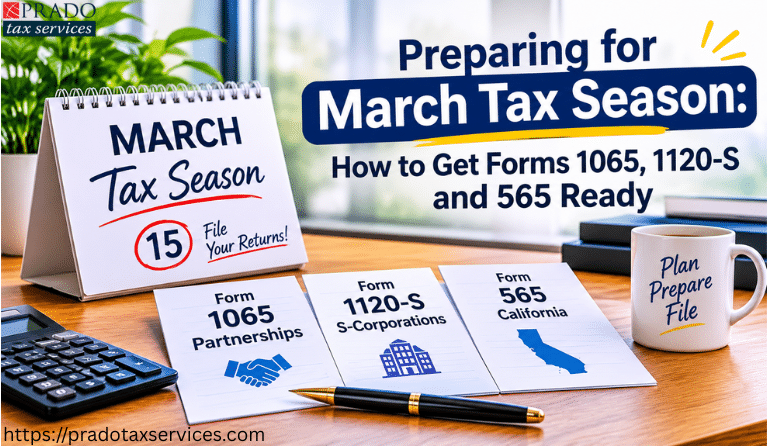
March can be a busy month for business owners. Along with managing daily operations and planning for the year ahead, partnerships and S-Corporations also need to prepare their business tax returns. The challenge is making sure financial records, ownership details, income reports and supporting documents are accurate before filing.
Forms 1065, 1120-S and 565 each have different reporting requirements, and choosing the correct forms is only the first step. Understanding what information to organize and what to review can make tax preparation easier and help businesses avoid unnecessary delays. If you need guidance with business tax preparation, Prado Tax Services offers professional tax services to help businesses navigate filing requirements and stay on top of their tax responsibilities.
Let’s explore how to get ready for March tax season.
Preparing for March Tax Season: How to Get Forms 1065, 1120-S and 565 Ready
Not every business files the same tax return. The forms a business needs depend on its legal structure, federal tax classification and state filing responsibilities.
For example, partnerships generally use Form 1065 to report their business income and other financial information to the IRS. S-Corporations use Form 1120-S, while certain partnerships doing business in California or receiving California-source income may also have to file Form 565 with the California Franchise Tax Board (FTB).
Here’s a quick comparison:
Tax Form | Business Type | Purpose |
Form 1065 | Partnerships | Reports partnership income, deductions, gains and losses to the IRS. |
Form 1120-S | S-Corporations | Reports an S-Corporation’s income, deductions and other tax information. |
Form 565 | Certain California partnerships | Reports partnership income and related information to California. |
What Are Forms 1065, 1120-S and 565, and Who Needs to File Them?
One important point is that federal and state tax filing requirements aren’t always identical.
Federal filing: The IRS uses Forms 1065 and 1120-S to collect information about the financial activities of partnerships and S-Corporations. These returns also provide information that passes through to partners or shareholders.
California filing: Businesses operating in California may have additional state reporting responsibilities. Depending on their classification and activities, they may need to file a separate return with the FTB.
This is particularly important for LLC owners. An LLC’s legal structure doesn’t automatically determine which tax return it files. Its tax classification matters.
Important: A California LLC classified as a partnership generally files Form 568, not Form 565. However, certain exceptions apply, including some nonregistered foreign LLCs. Always check the applicable California filing rules before selecting a return.
Before preparing any business tax return, confirm how the business is classified for federal and California tax purposes. Choosing the wrong form can lead to reporting errors and additional work later.
Getting Form 1065 Ready: What Partnerships Need to Organize
Form 1065, U.S. Return of Partnership Income, is generally used by partnerships to report their financial activities to the IRS. It provides an overview of the partnership’s income, deductions, gains, losses and other relevant tax information.
However, preparing the return involves more than adding up annual sales and expenses. Partnerships also need to review partner contributions, distributions and how business income or losses are allocated.
Here are the main areas to check.
Review Partnership Income
Start by reviewing all income earned during the tax year. Your records should give a clear picture of the partnership’s financial activity.
Gather information about:
- Total business revenue.
- Sales of products and services.
- Other business income.
- Interest, dividends and investment income, where applicable.
- Income reported through other business activities or investments.
Compare your accounting records with bank statements, invoices and sales reports. If the figures don’t match, investigate the difference before preparing the return.
Organize Deductible Business Expenses
Business expenses can affect the partnership’s taxable income, so it’s important to review them carefully.
Common expense categories include:
Expense Category | Examples of Records to Review |
Employee and contractor costs | Payroll reports, wage records and contractor payment records |
Rent and utilities | Lease agreements, rent receipts and utility bills |
Office and equipment | Office supply receipts and equipment purchase invoices |
Insurance | Business insurance policies and premium statements |
Advertising and marketing | Advertising invoices, campaign expenses and service bills |
Professional services | Accounting, legal and consulting invoices |
Don’t assume that every payment made by the business automatically qualifies as a deductible expense. Check the nature of each expense and keep supporting documentation.
Review Partner Information
Partnership returns also require accurate information about the people who own the business.
Before filing, review:
- Full names and addresses of all partners.
- Each partner’s ownership percentage.
- Capital contributions made during the year.
- Distributions and withdrawals.
- How profits and losses are allocated.
- Changes in ownership during the tax year.
For example, if a partner joined or left the business during the year, the partnership may need to review how that change affects ownership details and income allocations.
Keeping the partnership agreement and updated ownership records accessible can make this review easier.
Prepare Schedule K-1
Schedule K-1 (Form 1065) is an important part of partnership tax reporting. It shows each partner’s share of the partnership’s income, deductions, credits and other tax-related items.
The partnership prepares a separate Schedule K-1 for each partner and provides it to them so they can report the relevant information on their own tax returns.
Why does accuracy matter?
- Each partner needs the correct share of business income and deductions.
- Incorrect allocations can create inconsistencies between the partnership return and partners’ personal returns.
- Missing or incorrect information may require corrections and amended filings.
A useful preparation tip: Review the partnership’s financial records and ownership allocations together. This helps ensure that the amounts reported on the main return are consistent with the information provided to each partner.
Preparing Form 1120-S: What S Corporation Owners Should Check
S-Corporations have a different reporting process from partnerships. They generally file Form 1120-S, U.S. Income Tax Return for an S Corporation, to report their annual financial activity to the IRS.
Although an S-Corporation generally passes income, losses, deductions and credits through to its shareholders, the business still needs to file its own return and provide the relevant shareholder information.
Here are the key areas S-Corporation owners should review.
Review Annual Business Income
Begin by checking the company’s total income for the year.
Organize records covering:
- Gross receipts and sales.
- Returns and allowances.
- Other business income.
- Interest, dividends and investment income, where applicable.
Compare the amounts in your accounting software with bank deposits, sales reports and other financial records. This can help identify missing transactions or income that may have been recorded incorrectly.
Check Payroll and Shareholder Compensation
Payroll deserves particular attention when preparing an S-Corporation return.
Shareholder-employees who provide services to the business may need to receive reasonable compensation for those services. The business should review payroll records to make sure compensation has been handled appropriately.
Check the following:
- Employee payroll summaries.
- W-2 forms and wage information.
- Payroll tax records.
- Salary payments to shareholder-employees.
- Records supporting shareholder compensation decisions.
Why this matters: S-Corporation owners who work in the business shouldn’t overlook the distinction between wages for services and distributions as shareholders. The tax treatment of these payments can differ.
Organize Business Deductions
Next, review the expenses the company incurred during the year.
Common categories include:
- Employee salaries and wages.
- Office rent and utilities.
- Business insurance.
- Professional and accounting services.
- Depreciation on eligible business assets.
- Other ordinary and necessary business expenses.
Keep invoices, receipts, statements and other supporting records. If the business purchased equipment or other significant assets, review the purchase details and applicable depreciation records.
Prepare Shareholder Information
Form 1120-S also requires information about the company’s shareholders and their financial relationship with the business.
Review:
- Shareholder names and ownership percentages.
- Capital contributions.
- Distributions made during the year.
- Shareholder loans and repayment records.
- Stock and debt basis-related records.
- Allocation of income, deductions and credits.
These details can affect how the company’s financial results are reported and how shareholders calculate their tax positions.
Review Schedule K-1 (Form 1120-S)
Schedule K-1 (Form 1120-S) reports each shareholder’s share of the S-Corporation’s income, deductions, credits and other tax information.
Shareholders use this information when preparing their personal tax returns.
Before issuing the schedules, check that:
- Shareholder details are correct.
- Ownership information reflects the relevant tax year.
- Income and deduction allocations are consistent with the business return.
- Any relevant shareholder-level information has been reviewed.
A mistake on one shareholder’s K-1 can affect their personal tax reporting. That’s why the business should review these schedules carefully before distributing them.
California Form 565: What Partnerships Need to Know Before Filing
Partnerships with California business activities may have additional filing responsibilities beyond their federal Form 1065.
California Form 565, Partnership Return of Income, is used to report income, deductions, gains, losses and other relevant information to the FTB.
However, not every business that operates as an LLC or partnership should automatically use this form. The business’s classification and California filing circumstances matter.
Understand California Partnership Filing Requirements
A partnership generally needs to file Form 565 if it conducts business in California or has income from a California source.
California filing requirements can also depend on the entity’s registration and legal status. For example, California-registered limited partnerships and limited liability partnerships may have filing obligations even in certain circumstances where they aren’t actively conducting business in the state.
Before preparing Form 565, review these areas:
- California business activities: Determine whether the partnership conducts business in California or has California-source income.
- Income reporting: Review income earned from California activities and any relevant differences between federal and state reporting.
- Partner information: Confirm partner details and the allocation of income or losses.
- California Schedule K-1 (565): Prepare the applicable partner schedules with accurate state-specific information.
- State tax obligations: Review any applicable annual tax, withholding, payment or other filing responsibilities.
California doesn’t always follow federal tax treatment in every area. Certain adjustments may be necessary when preparing the state return.
Form 565 vs. Form 568: Which One Does Your LLC Need?
This is one of the areas that can cause confusion for California business owners.
Both forms relate to business tax reporting, but they aren’t interchangeable.
Feature | Form 565 | Form 568 |
Full name | Partnership Return of Income | Limited Liability Company Return of Income |
Generally used by | Certain partnerships | LLCs that aren’t taxable as corporations and meet California filing requirements |
Reporting purpose | Reports partnership income and related tax information | Reports LLC income and other applicable California tax and fee information |
Relevant business classification | Partnership | LLC classified as a partnership or another noncorporate tax classification covered by the form |
An LLC classified as a partnership generally files Form 568 if it meets California’s filing requirements. A partnership that isn’t an LLC may generally use Form 565 when required.
There are exceptions, so the distinction shouldn’t be treated as a simple rule based only on the business name.
Before choosing a form, confirm:
- Whether the entity is legally organized as a partnership or LLC.
- How the entity is classified for federal tax purposes.
- Whether it is registered or doing business in California.
- Whether it receives income from California sources.
- Whether a specific exception applies.
For California businesses, getting this distinction right can help prevent filing the wrong state return.
Business Tax Preparation Checklist: Documents You Shouldn't Overlook
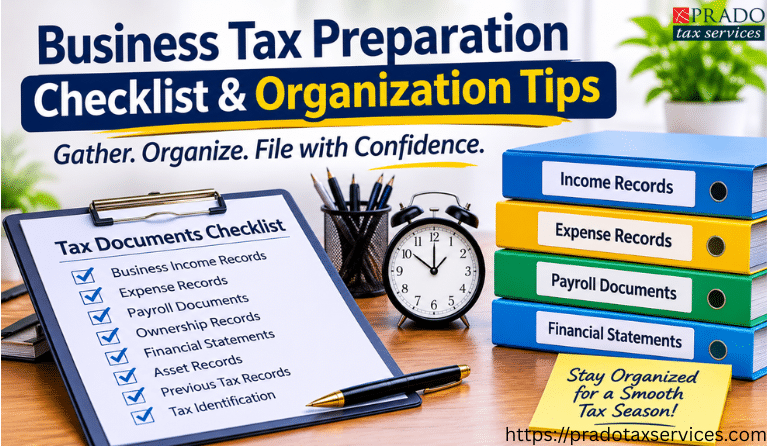
One of the easiest ways to make tax preparation more manageable is to gather the necessary documents before starting the return.
When financial records are scattered across emails, accounting software, spreadsheets and paper files, even a straightforward return can take longer to prepare.
Use this checklist to organize the main records your business may need.
Document Category | Examples |
Business income records | Sales reports, invoices and bank statements |
Expense records | Receipts, vendor bills and utility payments |
Payroll documents | W-2s, payroll summaries and employment tax records |
Ownership records | Partnership agreements and shareholder details |
Financial statements | Profit and loss statements and balance sheets |
Asset records | Equipment purchase invoices and depreciation schedules |
Previous tax records | Prior-year returns and supporting tax schedules |
Tax identification | EIN and relevant California identification numbers |
How to Keep Your Tax Documents Organized
You don’t need a complicated system to manage business tax records. A consistent process can make a noticeable difference.
Try these simple steps:
- Create separate folders for each category. Keep income, expenses, payroll, ownership and asset records in clearly labelled folders.
- Update your records regularly. Don’t wait until March to reconcile transactions or locate missing invoices. Review your accounts throughout the year.
- Keep digital copies. Store scanned receipts, invoices and statements in a secure location so they’re easier to retrieve when needed.
- Compare financial statements. Review your profit and loss statement, balance sheet and bank records to identify inconsistencies.
- Keep previous returns accessible. Prior-year filings can help when reviewing opening balances, depreciation records and other information that carries forward.
Quick reminder: Good tax preparation often begins months before the filing deadline. Keeping records organized throughout the year can reduce last-minute pressure and make it easier to identify missing information.
Tax Filing Mistakes Partnerships and S-Corporations Should Avoid
Even businesses with organized accounting systems can make mistakes when preparing their tax returns. Some errors are minor, while others can lead to incorrect reporting, additional correspondence or filing complications.
Here are eight common issues to watch out for.
- Mixing Personal and Business Expenses
Using business accounts for personal purchases can make it difficult to identify legitimate business expenses. Keep personal and business transactions separate wherever possible.
- Reporting Incorrect Business Income
Missing sales, recording duplicate transactions or overlooking other income can affect the accuracy of the return. Compare accounting records with bank statements and sales reports.
- Missing Receipts or Expense Documentation
An expense entry without supporting documentation can create problems if the business needs to explain or substantiate it. Keep relevant receipts, invoices and payment records.
- Entering Incorrect Partner or Shareholder Information
Changes in ownership, incorrect percentages or outdated contact details can affect reporting. Review ownership records before preparing the return.
- Miscalculating Distributions and Capital Accounts
Partnership contributions, distributions and capital account balances need careful review. S-Corporations also need appropriate shareholder stock and debt basis records. Don’t treat these calculations as interchangeable.
- Forgetting Schedule K-1
Partnerships and S-Corporations generally need to provide the applicable Schedule K-1 information to their partners or shareholders. Missing or inaccurate schedules can create problems for everyone involved.
- Confusing California Form 565 With Form 568
These forms serve different business filing purposes. Confirm the entity’s legal structure, tax classification and California filing requirements before choosing one.
- Waiting Until the Deadline to Organize Financial Records
Leaving document collection until the last minute increases the chance of missing information and rushed calculations. Start reviewing records early and address discrepancies before preparing the return.
The takeaway: Accurate tax filing depends on more than completing the right form. Businesses also need consistent records, correct ownership information and a clear understanding of their reporting responsibilities.
Understanding Form 7004 and Business Tax Filing Extensions
Sometimes a business needs more time to finalize its tax return. Financial statements may still be under review, important records may be missing, or the company may need additional time to confirm its reporting details.
In these situations, an eligible business may be able to request an extension to file its federal return.
What Is IRS Form 7004?
IRS Form 7004, Application for Automatic Extension of Time to File Certain Business Income Tax, Information, and Other Returns, allows eligible businesses to request additional time to submit certain tax returns.
Businesses filing Forms 1065 and 1120-S can generally use Form 7004 to request an automatic six-month extension.
For a calendar-year partnership or S-Corporation filing its 2026 tax-year return, the usual original federal filing deadline is March 15, 2027. If an eligible business properly requests the extension, the additional filing time generally runs for six months.
To request an extension:
- Identify the specific return that needs an extension.
- Complete the applicable sections of Form 7004.
- Make a reasonable estimate of any tax due, where applicable.
- Submit the extension request by the original return deadline.
- Keep confirmation and payment records for your files.
A separate Form 7004 is generally required for each return for which an extension is requested.
Does a Tax Filing Extension Give You More Time to Pay?
No. This is an important distinction that business owners shouldn’t overlook.
An extension gives eligible businesses more time to file their return. It doesn’t automatically provide more time to pay taxes that are due.
Consider the difference:
Filing Extension | Payment Deadline |
Provides additional time to submit an eligible tax return. | Generally remains tied to the original payment due date. |
Can help when financial records or return preparation aren’t complete. | Any required payment should be made by the applicable original deadline. |
Must be requested or obtained according to the relevant rules. | Late payments may result in penalties and interest. |
For federal Forms 1065 and 1120-S, an eligible business can generally receive a six-month filing extension through Form 7004.
California also has its own extension rules. The FTB generally allows a seven-month automatic extension for qualifying noncorporate business entities filing Form 565. However, the extension to file doesn’t remove applicable payment obligations.
Remember: Don’t confuse having additional time to complete a return with having additional time to pay. Review federal and California payment requirements separately to avoid unnecessary penalties and interest.
A Final Checklist Before Submitting Your Business Tax Returns
You’ve gathered the documents, reviewed the figures and prepared the relevant schedules. Before submitting your returns, take a few minutes to check the details one more time.
Use this final checklist:
- Confirm the business’s federal and California tax classification.
- Identify the correct federal and California tax forms.
- Reconcile business income and expenses.
- Review payroll records and shareholder compensation, where applicable.
- Verify partner and shareholder names and ownership details.
- Prepare the applicable Schedule K-1 forms.
- Check deductions and supporting documentation.
- Review prior-year tax returns and relevant carryforward information.
- Verify filing deadlines and payment obligations.
- Review the completed return before submission.
A final review can help identify missing information, inconsistent figures or incorrect schedules before the return is filed.
Get Your Business Tax Returns Ready With Professional Support
Preparing business tax returns involves more than filling in a few numbers. Partnerships and S-Corporations have different reporting requirements, and California businesses may have additional state filing responsibilities to consider.
From reviewing financial statements and organizing expense records to checking ownership information and preparing Schedule K-1 forms, each step needs attention.
Professional tax preparation support can help businesses:
- Review financial records before filing.
- Identify the applicable federal and California tax forms.
- Organize income, expenses and supporting documents.
- Review partner and shareholder reporting information.
- Prepare returns with greater attention to accuracy.
- Understand applicable filing and payment responsibilities.
Getting your financial records organized early can make the entire process less stressful. If you need help preparing your business tax returns, visit Prado Tax Services to learn more about its tax preparation services.
Frequently Asked Questions About March Business Tax Filing
For a partnership using a calendar tax year, Form 1065 for the 2026 tax year is generally due on March 15, 2027. If the due date falls on a weekend or federal holiday, the deadline generally moves to the next business day. Businesses with a different tax year may have a different filing date.
The documents needed depend on the company's activities, but common records include:
- Business income and sales reports.
- Bank statements and financial statements.
- Expense receipts and vendor invoices.
- Payroll summaries and W-2 information.
- Shareholder ownership records.
- Capital contribution and distribution details.
- Shareholder loan and basis-related records.
- Previous tax returns and depreciation schedules.
Having these records ready can make it easier to review the company's financial activity and prepare the return.
No. A California LLC classified as a partnership generally files Form 568 rather than Form 565. However, certain exceptions apply, including some nonregistered foreign LLCs. The correct form depends on the LLC's tax classification, registration and California activities.
Yes. Eligible partnerships and S-Corporations can generally use IRS Form 7004 to request an automatic six-month extension to file Forms 1065 and 1120-S. The request must be submitted by the original filing deadline. Remember that an extension to file doesn't automatically extend the time to pay any tax due.
Form 1065 is generally filed by partnerships to report their income, deductions, gains and losses to the IRS. Form 1120-S is filed by businesses that have elected and qualify for S-Corporation tax treatment. Both forms report business financial information and provide Schedule K-1 information to their respective partners or shareholders, but their reporting requirements differ.
You can download Forms 1065 and 1120-S from the IRS website and California Form 565 from the FTB website. Gather your financial records and ownership details, then use compatible tax software to prepare and e-file eligible returns. For complex filings, consider consulting a qualified tax professional.
Partnerships filing Form 1065 provide Schedule K-1 to each partner, while S-Corporations filing Form 1120-S issue it to their shareholders. The document reports each individual's share of business income, deductions, credits and other tax-related information for their personal tax returns.