
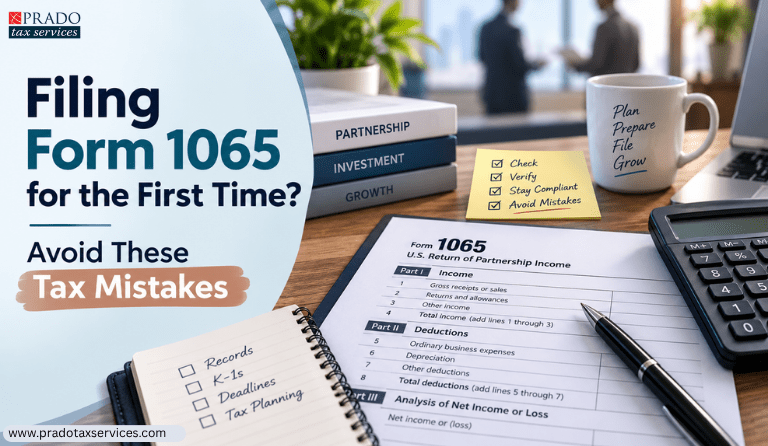
Filing Form 1065 for the first time can feel straightforward until you start sorting through partnership income, partner transactions, ownership details, and Schedule K-1 information. A small mistake in your books or business tax filing can carry over into a partner’s personal return and create more work later. Good small business tax preparation starts well before you enter numbers on the form. In this guide, we’ll cover the most common Form 1065 mistakes first-time filers make, from using the wrong return and misclassifying partner transactions to overlooking K-1 details, mishandling business purchases, and missing important tax planning considerations. The goal is simple: help you approach your business tax return with fewer surprises and a clearer idea of what needs to be reviewed before filing.
Before Filing Form 1065, Confirm It's the Right Return
The first step in Form 1065 filing is making sure Form 1065 is actually the return your business should file. Partnerships generally use Form 1065 to report their income, deductions, gains, losses, and other tax information. However, an LLC’s legal structure doesn’t automatically determine its federal tax treatment. A multi-member LLC, for example, may be treated as a partnership for federal tax purposes, but an LLC can have a different tax classification depending on its circumstances and elections. Before preparing the return, confirm how the business is classified for federal tax purposes. If you’re still sorting out how your LLC’s classification affects its tax return, the guide on filing business taxes for an LLC for the first time can help clarify the filing process. Filing the wrong return can create unnecessary corrections and complications before you even get to the numbers.
Mistake #1: Filing Form 1065 With Unreconciled Books
One of the easiest ways to create problems on a first partnership return is to start business tax preparation before the books are actually ready. If bank accounts haven’t been reconciled, transactions are missing, or expenses are sitting in the wrong categories, the numbers you enter on Form 1065 may not accurately reflect the partnership’s financial activity. Personal and business spending can also get mixed together, making it harder to determine which expenses belong to the partnership. Year-end balances deserve extra attention, too, especially when there are unusual transactions or adjustments. Missing receipts and other supporting records can make it difficult to substantiate expenses later.
Before starting your small business tax preparation, take a few minutes to work through the basics:
- Reconcile all business bank accounts.
- Reconcile business credit card accounts.
- Review unusual or large transactions.
- Separate personal spending from business expenses.
- Check year-end balances and entries.
- Make sure receipts and supporting records are available.
- Correct transactions that were recorded in the wrong account.
Don’t start with the tax form. Start with accurate books.
Mistake #2: Misclassifying Partner Contributions, Distributions, and Loans
During partnership tax preparation, it’s important to distinguish between money generated by the business and money moving between the partnership and its partners. First-time filers can easily mix these transactions up, especially when a partner regularly puts money into the business or takes money out. These amounts don’t automatically represent business income or expenses, and recording them incorrectly can affect the partnership’s financial records and Form 1065 filing.
Four Transactions First-Time Filers Can Easily Mix Up
Transaction | What It Represents | Common Mistake |
Partner contributes cash | Capital contribution | Recording it as business revenue |
Customer pays the partnership | Business income | Treating it as partner funding |
Partner takes money from the business | Distribution | Recording it as a business expense |
Partner lends money to the partnership | Loan to the partnership | Recording it as sales income |
A partner contribution is money or property a partner puts into the partnership. It isn’t ordinary business revenue simply because it appears in the partnership’s bank account. The same goes for a distribution. When a partner takes money out of the business, that transaction shouldn’t automatically be treated as a deductible business expense.
A loan from a partner to the partnership is different from a contribution because the partnership has an obligation to repay the borrowed amount. Keeping that loan separate from partner capital helps maintain clearer records and prevents borrowed funds from being mistaken for business income.
The easiest rule to remember is to follow where the money came from and why it moved. Customer payments are business revenue. Partner funding is not automatically revenue, and money paid to a partner is not automatically a business expense. Getting these distinctions right early can make the rest of the partnership tax preparation process much cleaner.
Mistake #3: Assuming Partnership Income Is Automatically Split 50/50
Having two partners doesn’t necessarily mean partnership income and losses should be divided equally. The allocation may depend on the partners’ ownership interests, the terms of the partnership agreement, and how profits and losses are structured. Simply taking the partnership’s total income and dividing it in half can lead to inaccurate reporting when the partners have different ownership percentages or agreed to a different allocation.
The partnership agreement is an important reference when preparing the return because it can establish how profits, losses, and other tax items are allocated among the partners. Changes during the year can also affect those calculations. For example, if a partner’s ownership interest changes during the year, the allocation may need to reflect that change rather than applying one percentage to the entire year.
Capital accounts should also be reviewed alongside the allocation information to help ensure the partners’ reported interests are consistent with the partnership’s records.
The key point: don’t assume 50/50 just because there are two partners. Check the ownership structure and partnership agreement before allocating income or losses.
Mistake #4: Treating Schedule K-1 as an Afterthought
How a K-1 Error Can Affect a Partner's Tax Return
A partnership return isn’t complete just because the numbers on Form 1065 look right. Each partner also receives a Schedule K-1, which reports that partner’s share of the partnership’s tax information for use on their own tax return. The process should line up from start to finish:
Partnership records → Form 1065 → Schedule K-1 → Partner’s tax return
Before issuing K-1s, review each partner’s identifying information and ownership details, along with the income, deductions, and credits reported to them. The information on the K-1 should also be consistent with the amounts reported on the partnership’s Form 1065. Even a small error in a partner’s information or reported amounts can create confusion when that partner prepares their personal return.
It’s worth reviewing every K-1 carefully rather than treating it as a form that’s automatically generated at the end. Prado’s Schedule K-1 tax form resources can also be useful when checking the forms involved in partnership tax reporting.
Mistake #5: Misunderstanding How Business Expenses, Assets, and Tax Credits Are Treated
Another common mistake in business tax preparation is assuming that every business purchase can be handled the same way on the tax return. Ordinary business expenses should be properly documented, with records showing what was purchased and its business purpose. Some expenses may also need additional review before they’re treated as deductible. Keeping receipts and supporting documentation can make it easier to determine the appropriate tax treatment.
Business assets require a closer look, too. Equipment, computers, furniture, vehicles, and other property used by the partnership may not be treated like routine operating expenses. Depending on the purchase and how the property is used, it may need to be treated as an asset rather than deducted as an ordinary expense. This is an important distinction for first-time filers because the way something is entered in the books doesn’t necessarily determine how it should appear for tax purposes.
Tax credits deserve similar attention. Don’t assume an expense automatically qualifies for a credit simply because it’s related to the business. Tax credit eligibility depends on the requirements of the specific credit. The same applies to federal tax credits, which should be reviewed carefully before being claimed.
The goal isn’t to memorize every deduction or credit. It’s to recognize when a transaction needs a closer tax review rather than assuming the bookkeeping treatment tells the whole story.
Mistake #6: Forgetting That Form 1065 Can Affect Estimated Tax Planning
How Business Tax Planning Can Help Avoid Estimated Tax Penalties
Filing Form 1065 doesn’t necessarily end the tax planning process. The partnership’s income is reported to the partners through Schedule K-1, and that information can affect each partner’s personal tax liability. The basic flow is Form 1065 → Schedule K-1 → Partner’s share of income → Personal tax planning. A partner may have taxable income from the partnership even when they didn’t receive the same amount in cash, so waiting until filing season to think about taxes can create an unpleasant cash-flow surprise.
This is where business tax planning can make a difference. Partners can review projected partnership income during the year and adjust their estimated tax payments when their expected tax liability changes. Keeping an eye on income throughout the year can also help partners avoid estimated tax penalties that may result when required payments aren’t made on time or aren’t sufficient.
Common Situations That Can Create a Tax-Planning Surprise
Situation | Why It Matters | Planning Step |
Partner receives higher K-1 income than expected | Personal tax liability may increase | Revisit estimated tax payments |
Partnership income changes during the year | Earlier estimates may no longer fit | Recalculate projections |
Partner receives taxable income without a cash distribution | Tax may still be due | Set aside funds |
Tax planning starts only at filing time | Cash-flow surprises are more likely | Review projections earlier |
The key is to treat the partnership return as part of an ongoing tax-planning process, not something that only matters when the return is due. Understanding how partnership income may flow through to each partner gives everyone more time to prepare for the personal tax bill and potentially reduce estimated tax penalties.
Mistake #8: Assuming E-Filing Will Catch Your Mistakes
When You May Need Help Filing Tax Online
E-filing can make it faster and more convenient to file taxes online, but it doesn’t mean the return has been prepared correctly. Tax software or an electronic filing system may identify certain missing fields or obvious errors, but it can’t always tell whether the information you entered reflects the partnership’s actual tax situation. A wrong tax classification, incorrect allocation, inaccurate partner information, missing documentation, or misclassified transaction can still make its way into the final return.
If you’re comfortable preparing the return but need help filing tax online, make sure the information has been reviewed before submitting it. For a first-time Form 1065 filer, getting the underlying records and tax treatment right is more important than simply choosing the quickest filing method.
E-filing makes submission easier. It doesn’t replace careful tax preparation.
Your First Form 1065 Pre-Filing Checklist
Before submitting your first Form 1065, take a final pass through the return and supporting records. A simple checklist can help catch issues that are easy to miss when you’re focused on getting the filing completed.
Return
- ☐ Confirm Form 1065 is the correct federal return.
- ☐ Confirm the partnership’s tax classification.
Books
- ☐ Reconcile bank and credit card accounts.
- ☐ Review business income and expenses.
- ☐ Check unusual or large transactions.
Partners
- ☐ Verify partner information.
- ☐ Confirm ownership percentages.
- ☐ Review contributions and distributions.
- ☐ Check ownership changes.
- ☐ Review the partnership agreement.
Tax Treatment
- ☐ Review business assets.
- ☐ Check potentially deductible expenses.
- ☐ Review applicable tax credits.
Final Review
- ☐ Check Form 1065 for consistency.
- ☐ Review every Schedule K-1.
- ☐ Consider whether estimated tax payments need attention.
- ☐ Review the complete return before filing.
Taking a few extra minutes for this final review can help catch errors before they become filing or partner-reporting problems.
When Your First Form 1065 May Need Professional Help
Filing your first Form 1065 doesn’t necessarily mean you need professional help, but some situations can make the return much harder to prepare accurately. If the partnership has multiple partners, ownership changed during the year, or partner transactions are complicated, there may be more details to review than a first-time filer expects. The same is true if the books need cleanup, the business purchased or sold significant assets, or you’re unsure how partnership income should be allocated. K-1 information that doesn’t match the partnership records is another reason to pause before filing. And if you’re not sure whether Form 1065 is the correct return or what filing requirements apply, getting advice before submitting the return can save time and prevent avoidable corrections.
Get Help With Small Business Tax Preparation
For a first-time partnership, professional small business tax services can take some of the uncertainty out of the preparation process. A tax preparer in San Leandro can help review your partnership records, partner information, allocations, and K-1s before filing. Businesses elsewhere in the Bay Area may also look for a tax professional in San Leandro or an experienced tax preparer in Bay Area CA who understands partnership returns.
If you need more comprehensive business tax services in San Leandro, or from around the Bay Area, Prado Tax Services can help you work through the preparation and filing process, including partnership tax returns. Getting the return reviewed before filing can be especially valuable when you’re dealing with a first-time Form 1065 and aren’t sure whether everything lines up.
Can It Be Filed Remotely?
Yes. You don’t necessarily need to visit the Prado Tax Services office to get help with your first Form 1065. You can start remotely by contacting Prado Tax Services through the contact us page or by calling (888) 829-1125. The team will ask a few questions about your partnership, tax situation, and filing needs so they can understand what forms and information may be required.
Once your situation is reviewed, Prado Tax Services can guide you through the filing process and let you know which documents are needed. You can then provide your tax documents electronically through the firm’s online document system, making it possible to work through the preparation process without making an in-person visit. Prado’s online process includes completing an initial contact form, registering, filling out a checklist, reviewing the required documents, uploading them securely, and completing a final tax review.
This can be especially helpful if you’re filing Form 1065 for the first time and aren’t sure what information to gather. Instead of trying to figure out every requirement on your own, you can contact the team, answer a few questions, provide the requested partnership and financial documents, and receive guidance throughout the preparation and filing process.
Conclusion
Filing Form 1065 for the first time doesn’t have to be overwhelming, but the details matter. Unreconciled books, incorrectly classified partner transactions, inaccurate income allocations, K-1 errors, and misunderstandings about how expenses, assets, or credits are treated can all create problems. Rushing through the return only makes those mistakes easier to miss. Taking the time to review your records, partner information, tax treatment, and final forms can help you catch issues before the return is submitted.
If you’re preparing your first partnership return and aren’t confident that everything lines up, Prado Tax Services can help. Our small business tax preparation services are designed to help businesses organize their records, review partnership tax details, and prepare their returns accurately. With professional business tax services, you can approach your first Form 1065 with greater confidence and less last-minute stress.